
Selecting antifoams and defoamers
Technical Guide to Chemical Classification and Industrial Applications
Foam as an industrial process challenge
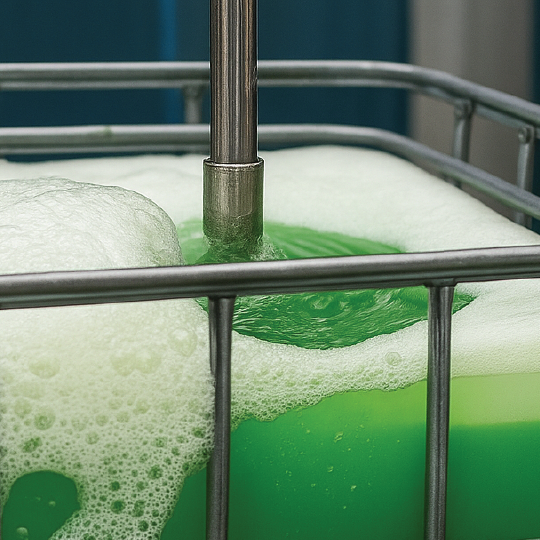
From a process engineering standpoint, unwanted foam formation is a colloidal disturbance that reduces the effective volumetric capacity of reactors, increases cycle times, and can trigger operational failures in pumps, filtration units, level sensors, and aerated systems.
Commercially, antifoams and defoamers are not selected on the basis of universal efficacy alone. Their performance depends on chemical compatibility with the process medium, aqueous or non-aqueous, thermal stability, dosage behavior, and regulatory suitability, including food-contact or processing requirements where applicable.
The following sections outline four major antifoam and defoamer families currently used in industrial markets, based on colloid chemistry principles and technical specifications commonly applied in fine chemical and process industries.

Silicone-based Antifoams and Defoamers
The active component is typically polydimethylsiloxane (PDMS), often modified with organic groups such as polyether-functional silicones or reinforced with hydrophobic silica to improve mechanical foam-breaking efficiency. These products are marketed as neat fluids, oil-in-water emulsions, or silica-containing compounds.
Silicone fluids have very low surface tension, typically around 20–21 mN/m, which gives them a high spreading coefficient and allows rapid propagation across the bubble surface. Hydrophobic silica acts as a rupture nucleus by penetrating the air-liquid interface and destabilizing the lamella through entry and bridging mechanisms. Common industrial applications include:
Key technical limitations include difficult cleanup or removal from equipment and restricted use in certain food-related processes unless the specific grade is authorized for the intended application.
Oil-based Antifoams and Defoamers: Non-silicone organic systems
These formulations use mineral oils, vegetable oils such as epoxidized soybean oil, or animal-derived fats, combined with microcrystalline waxes and long-chain fatty acids such as stearic or palmitic acid. They may also contain hydrophobic particles, including treated silica or metallic stearates, to enhance the bridging effect that ruptures the liquid film.
Oil-based systems act by displacing surfactant molecules at the air-liquid interface. Because they have low water solubility, they penetrate the bubble lamella and create a local surface-tension gradient that accelerates drainage until the foam film collapses. Common industrial applications include:
Their main technical limitations are lower persistence at elevated temperatures, particularly above approximately 80 °C, and a tendency to generate spots, stains, or surface defects in finished substrates.
Polyether Antifoams and Defoamers: EO/PO copolymers
This family includes block copolymers of ethylene oxide (EO) and propylene oxide (PO). The EO/PO ratio defines the hydrophilic-lipophilic balance (HLB). PO-rich grades are typically poorly soluble in water at ambient temperature, while EO-rich grades may exhibit a cloud point: above a defined temperature, they become less soluble and activate their antifoaming or defoaming effect in situ.
Polyether antifoams and defoamers are amphiphilic materials. At lower temperatures, some grades may behave as surfactant-like stabilizers; once the cloud point is reached, molecular precipitation at the interface displaces the foaming agents. A key advantage is that they do not leave persistent silicone or oily residues. Common industrial applications include:
Their effectiveness is highly dependent on process temperature, cloud-point design, pH, and surfactant load. For this reason, polyether systems generally require calibrated dosing curves and validation under actual process conditions.
Powder Antifoams and Defoamers: Solid delivery systems
Powder antifoams and defoamers consist of active materials, such as adsorbed silicones or mineral oils, supported on mineral carriers including magnesium silicate, calcium carbonate, or cellulose, as well as organic polymers such as high-molecular-weight polyethylene glycol. They are supplied with controlled particle-size distributions, often below 100 microns depending on the application.
They operate through gradual dissolution or mechanical breakdown of the particles in the medium. Controlled release of the hydrophobic active phase occurs at the solid-liquid interface, where it helps adsorb or displace the proteins, surfactants, or process additives responsible for foam stabilization. Common industrial applications include:
A key limitation is incompatibility with systems involving excessive mechanical shear that can over-fracture the carrier and compromise the controlled-release effect.
There is no universal Antifoam or Defoamer
From a process engineering perspective, antifoam or defoamer selection should not be based solely on apparent knockdown speed. It should be based on the product’s kinetic specificity within the system where it will be applied. Technical literature, including Defoaming: Theory and Industrial Applications by P. R. Garrett, shows that antifoam and defoamer performance is influenced by variables such as liquid-film drainage rate, medium viscosity, electrolyte concentration, surfactant package, and operating temperature.
In B2B applications, suppliers should support selection through testing with actual process-fluid samples, such as mother liquor, wastewater, coating intermediates, or fermentation broth. The evaluation should measure foam-collapse rate, persistence over time, compatibility with the final product, and the risk of overdosing, which can increase operating costs or introduce cross-contamination.
f you need support, Zerachem's technical team is available to answer your questions and provide application guidance.
Disclaimer: This article is provided for general technical and informational purposes only and does not constitute legal, regulatory, safety, or application-specific advice. Product selection, dosage, handling, and compliance requirements should be validated through laboratory testing, review of the applicable safety data sheet, and consultation with qualified technical, regulatory, and legal professionals. Regulatory status may vary by product grade, intended use, industry, jurisdiction, and end application, including U.S. food-contact or processing requirements.
Frequently Asked Questions
What chemical breaks down foam?
There is no single universal chemical that breaks foam in every system. Foam collapse depends on compounds with low dynamic surface tension, poor solubility in the foaming medium, and a positive spreading coefficient at the air-liquid interface.
Commercially used active chemistries include polydimethylsiloxanes (silicones) with hydrophobic silica, EO/PO copolymers activated near their cloud point, fatty acid esters or long-chain alcohols, and paraffinic hydrocarbons formulated with microcrystalline waxes. The appropriate chemistry depends on whether the process medium is aqueous, non-aqueous, high-temperature, food-related, or sensitive to residues.
What are the main types of antifoams and defoamers?
Industrial antifoams and defoamers are typically classified by chemistry and physical form into four main groups: oil-based organic systems, silicone-based systems, polyether antifoams and defoamers, and powder antifoams and defoamers. Oil-based systems use mineral or vegetable oils combined with waxes and hydrophobic solids. Silicone systems generally rely on PDMS fluids, silicone emulsions, or silica-reinforced compounds.
Polyether antifoams and defoamers are nonionic EO/PO block copolymers whose activity may depend on temperature and cloud-point behavior. Powder antifoams and defoamers contain active materials adsorbed onto mineral or organic carriers for solid-form applications.
What can be used as an antifoam or defoamer in industrial applications?
In B2B industrial environments, only engineered antifoam or defoamer formulations should be used. Typical options include silicone emulsions, 100% active liquid polyethers, mineral-oil compounds containing hydrophobic silica, and free-flowing powder antifoams and defoamers based on mineral or polymeric carriers.
Selection should be made according to process chemistry, temperature, pH, agitation profile, downstream compatibility, and regulatory requirements. Household materials such as cooking oil, vinegar, salt, or detergent should not be used because they lack controlled interfacial performance and can introduce contamination or even increase foam formation.
Can an antifoam or defoamer be made at home?
Not for industrial use. Effective antifoams and defoamers require controlled particle dispersion, defined droplet-size distribution, hydrophobic filler activation, and stable emulsification or carrier design.
These parameters require specialized equipment such as high-shear mixers, homogenizers, three-roll mills, and validated quality-control methods. Informal mixtures of oil, water, and detergent are unstable dispersions and may behave as surfactant systems that increase foam rather than suppress it.
Is vinegar an antifoam or defoamer?
No. Vinegar is an aqueous solution of acetic acid and does not function as a true antifoam or defoamer. In specific food or household contexts, acidification may reduce foam indirectly by changing protein charge or modifying pH-sensitive surfactant behavior.
However, this is not the same as interfacial foam rupture through spreading, film entry, and lamella destabilization. In industrial systems, vinegar should not be considered an antifoaming or defoaming agent.
Is salt an antifoam or defoamer?
Not in the strict industrial sense. Sodium chloride is a strong electrolyte, and its effect on foam depends on the surfactant system. In ionic systems, salt can compress the electrical double layer and reduce film stability. In some nonionic systems, electrolytes can influence cloud-point behavior.
However, salt does not break foam through interfacial spreading or controlled lamella rupture, and it is not classified or used commercially as an industrial antifoam or defoamer.
How is an industrial antifoaming or defoaming agent manufactured?
Industrial antifoam and defoamer manufacturing depends on the formulation type. In a silicone-based compound, PDMS is typically blended with hydrophobic fumed silica under controlled shear until the solid phase is uniformly dispersed.
If an oil-in-water emulsion is required, the active phase is emulsified with demineralized water and suitable nonionic emulsifiers, followed by homogenization to achieve a controlled internal-phase droplet size. Viscosity modifiers, preservatives, and stability aids may be added depending on shelf-life, transport, and application requirements.
What does an antifoam or defoamer contain?
An antifoam or defoamer typically contains an active antifoaming or defoaming phase, a hydrophobic solid or filler, a spreading or dispersing aid, and a delivery vehicle. The active phase may be mineral oil, PDMS, EO/PO copolymer, or a fatty ester. Hydrophobic fillers such as amorphous silica or metallic stearates help penetrate and destabilize foam films.
The delivery vehicle may be water in emulsions, oil in compounds, or a mineral or polymeric carrier in powders. The exact composition depends on process compatibility, regulatory status, and required performance.
What is the formula for an industrial degreaser?
This question falls outside the antifoam and defoamer category because degreasers are cleaning formulations rather than foam-control additives. A typical alkaline water-based industrial degreaser may contain anionic and nonionic surfactants, chelating agents, alkaline builders, and hydrotropic or glycol-based solvents.
Because surfactants often generate foam, industrial degreasers may require a compatible antifoam or defoamer, commonly a silicone or polyether system, when used in spray washers, recirculating tanks, or high-agitation cleaning processes.
What happens if too much antifoam or defoamer is used?
Overdosing can reduce antifoam or defoamer efficiency and create secondary process issues. Excess active material may remain dispersed rather than spreading at the interface, producing a pro-foaming effect in some systems.
It may also contaminate the final product, cause craters or fisheyes in coatings, generate oily stains in textiles, increase organic load in wastewater, reduce heat-transfer efficiency, or foul filtration membranes. For this reason, dosage should always be optimized through bench testing and validated under actual operating conditions.
Why Partner With Us
30 Years Focused on Chemical Excellence
Backed by quality certifications, reliable logistics, and a comprehensive chemical portfolio tailored to your industry.

KOSHER
Certified

Agile
Reformulation

Permanent
Stock

Full Regulatory
Compliance

Technical
Sustainability

Organized
Logistics

Specialized
Consulting

Free
Samples
Let’s start your next project.
Let’s start your next project
Describe your needs and let’s put the plan into action: technical assessment, samples for your validation and approval, and full support to implement the raw material that best fits your requirements and process.
We’re ready!