
Palm oil
Composition, functional properties, industrial applications, and sustainability
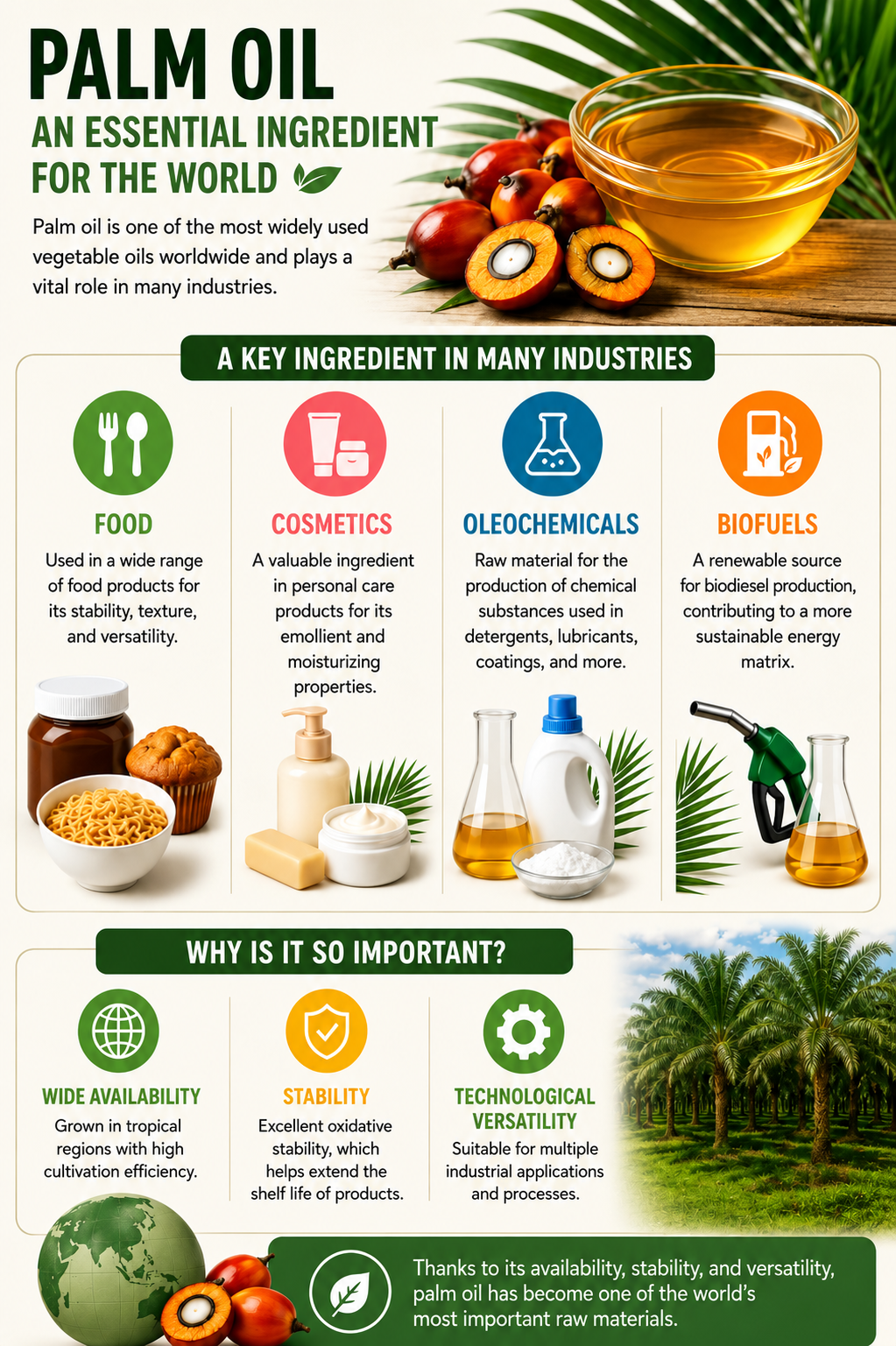
Palm oil is one of the world’s most widely used vegetable oils and is one of the world’s most important renewable feedstocks across the food, personal care, oleochemical, and biofuel industries. Its unique combination of availability, oxidative stability, functional versatility, and processing performance has made it an essential raw material in numerous industrial applications.
Beyond the public debate surrounding nutrition and sustainability, palm oil possesses physicochemical characteristics that distinguish it from many other vegetable oils. Its balanced fatty acid composition, natural semi-solid consistency, and resistance to oxidative degradation allow manufacturers to formulate products with enhanced stability, extended shelf life, and consistent processing performance.
Palm oil chemistry: Why its composition matters
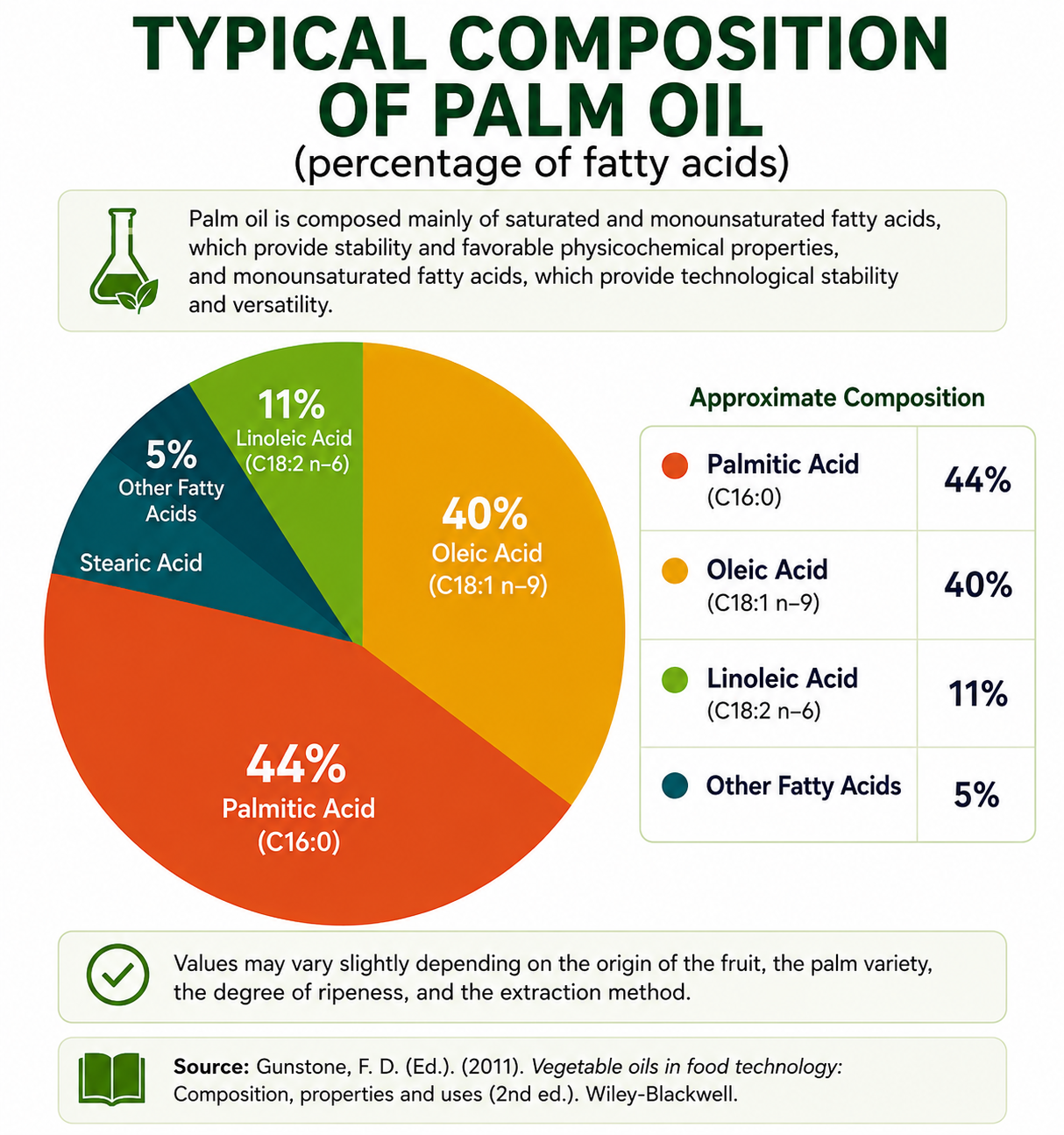
Palm oil is obtained from the mesocarp of the fruit of the oil palm (Elaeis guineensis). Unlike palm kernel oil, which is extracted from the seed and exhibits a markedly different fatty acid profile, palm oil is characterized by a relatively balanced distribution of saturated and unsaturated fatty acids.
This composition has a higher level of saturation compared with most common vegetable oils, such as soybean, sunflower, or canola, yet it is significantly lower than that of coconut oil.
Saturated fatty acids, lacking carbon‑carbon double bonds, are less susceptible to autoxidation and therefore contribute to greater oxidative and thermal stability. while monounsaturated fatty acids help maintain the desired fluidity and functional performance during processing.
This balanced fatty acid profile explains why palm oil performs reliably across a wide range of industrial applications.
Oxidative Stability: A Key Technological Advantage
One of the main challenges in the storage and processing of vegetable oils is lipid oxidation, a process that leads to the formation of hydroperoxides and secondary compounds responsible for oxidative rancidity, off-flavors, aroma changes, quality loss, and reduced product shelf life.
Because of its fatty acid composition, characterized by a lower proportion of polyunsaturated fatty acids compared with other vegetable oils such as soybean, corn, or conventional sunflower oil—and the presence of natural antioxidants such as tocopherols and tocotrienols, palm oil generally exhibits greater oxidative stability than vegetable oils with higher concentrations of polyunsaturated fatty acids.
This property supports its use in applications that require resistance to oxidation during storage or exposure to high-temperature processing.
Why Is Palm Oil So Controversial?
Most discussions around palm oil focus on two main areas: nutrition and sustainability.

Nutritional Profile
Palm oil contains a significant proportion of saturated fatty acids, which is why it has been the subject of numerous studies related to cardiovascular health.
Current evidence suggests that the health effects of dietary fats depend on the overall dietary pattern rather than on a single ingredient.
From a technological standpoint, an important advantage is that palm oil can provide stability without requiring partial hydrogenation, a process that may generate trans fatty acids.
Sustainability
Most current concerns stem from the environmental impact associated with the expansion of oil palm cultivation in some producing regions. The issues most frequently raised include:
- Loss of forest cover.
- Impacts on ecosystems.
- Reduction of wildlife habitat.
- Social and labor conflicts in certain producing areas.
It is important to note that these issues do not represent all supply chains. In response to these concerns, certification schemes have emerged to promote more sustainable agricultural and commercial practices, with RSPO certification being one of the most widely recognized internationally.
Although certification does not eliminate every environmental challenge, it establishes standards intended to improve traceability, responsible agricultural practices, and supply chain transparency.
Palm oil remains one of the industry’s most important raw materials because of its combination of stability, functionality, and versatility.
Like any ingredient, it should be evaluated by considering technical, nutritional, economic, and environmental factors together.
Evidence-based decisions supported by technical criteria enable companies to develop more efficient, sustainable, and competitive formulations.
FAQ: Answers to the Most Common Questions About Palm Oil
What is palm oil, and why do some people consider it unhealthy?
Palm oil is a vegetable oil obtained from the mesocarp of the Elaeis guineensis fruit. Its composition is approximately 50% saturated fatty acids and 50% unsaturated fatty acids, with palmitic acid and oleic acid as the predominant fatty acids. Concerns about palm oil consumption are mainly related to its saturated fat content. When saturated fat sources replace unsaturated fat sources in the diet, they may contribute to increased LDL cholesterol and, consequently, higher cardiovascular disease risk. However, its impact should be assessed within the context of a person’s overall dietary pattern.
Why does palm oil have a negative perception?
Public perception of palm oil is mainly influenced by two factors. It is important to note that these effects are not inherent to palm oil as a raw material. They depend on production practices and supply chain management. In other words, industry must continue moving toward more sustainable production systems.
What does the World Health Organization say about palm oil?
The World Health Organization (WHO) does not prohibit palm oil consumption but has included palm oil and coconut oil in its plan to develop a specific guideline on tropical oils. Its current recommendation focuses on limiting total saturated fat intake to less than 10% of total energy intake, within a healthy dietary pattern that favors unsaturated fats. Its recommendations focus on limiting total saturated fat intake and, when possible, favoring unsaturated fats within a healthy dietary pattern. As a result, palm oil can be part of the diet as long as consumption remains within general nutrition recommendations.
What functional properties make palm oil valuable in industrial applications?
From a technical perspective, palm oil offers functional properties that explain its widespread use in the food and oleochemical industries: High oxidative stability, which helps extend product shelf life and improve performance during high-temperature processingm, Excellent functional performance, since it can be fractionated into olein and stearin with specific properties for different applications, No need for partial hydrogenation to achieve certain functional characteristics, helping avoid the formation of industrial trans fats and Red or minimally refined palm oil retains bioactive compounds such as carotenoids and tocotrienols; however, conventional refining significantly reduces many of these compounds.
Why has palm oil become a topic of public debate?
The most common reasons include: concern about saturated fat content, environmental impacts associated with certain production models and consumer preferences and formulation strategies focused on “palm oil-free” products. Nevertheless, certification systems and sustainability programs are designed to help reduce the environmental and social impacts associated with palm oil production.
What are the differences between palm oil, palm olein, and palm stearin?
Palm oil is obtained from the fruit of the oil palm and serves as the raw material from which different fractions are produced through a physical process known as fractionation, based on controlled crystallization of triglycerides.
This process mainly produces two fractions:
- Palm olein: the liquid fraction, characterized by a higher content of unsaturated fatty acids. It offers good fluidity at room temperature and high oxidative stability, supporting its use in frying oils, processed foods, and various industrial applications.
- Palm stearin: the solid fraction, with a higher concentration of high-melting-point triglycerides. It is used as a functional ingredient in margarines, shortenings, bakery fats, confectionery, and other formulations where specific consistency, structure, and stability properties are required.
Why Partner With Us
30 Years Focused on Chemical Excellence
Backed by quality certifications, reliable logistics, and a comprehensive chemical portfolio tailored to your industry.

KOSHER
Certified

Agile
Reformulation

Permanent
Stock

Full Regulatory
Compliance

Technical
Sustainability

Organized
Logistics

Specialized
Consulting

Free
Samples
PRODUCT SOLUTIONS
Get direct access to our specialty product line: antifoams, emulsions, degreasers, and more.
INDUSTRY SOLUTIONS
Explore the solutions we’ve already formulated to address the unique demands of your sector.
Let’s start your next project.
Let’s start your next project
Describe your needs and let’s put the plan into action: technical assessment, samples for your validation and approval, and full support to implement the raw material that best fits your requirements and process.
We’re ready!