
Degreasers for the Oil and Gas Industry
The oil and gas industry operates in environments where the buildup of grease, oil, and carbonized deposits affect nearly every operation. Grease on work surfaces, as well as on equipment exposed to tar and hydrocarbons, creates persistent day-to-day challenges not only because of occupational health and safety risks, but also because it can shorten equipment service life and potentially cause operational downtime.
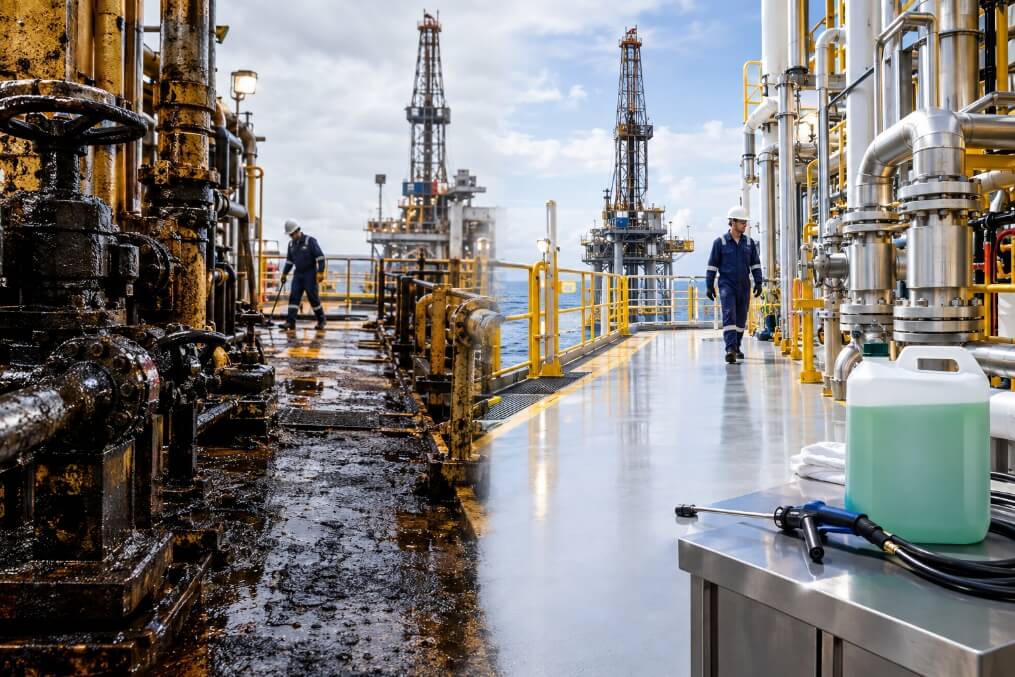
From drilling platforms to refineries and petrochemical plants, effectively cleaning hydrocarbon-contaminated surfaces is a critical requirement that directly affects operational safety, productivity, and environmental sustainability.
Industrial degreasers formulated specifically for this sector must meet technical and regulatory requirements that go far beyond those of conventional cleaning products. Selecting the right degreaser requires evaluating its ability to remove heavy grease, its compatibility with equipment materials, its safety profile, and its compliance with applicable environmental regulations. This article reviews the use of degreasers in the oil and gas industry.
Grease and deposit buildup in oil and gas operations
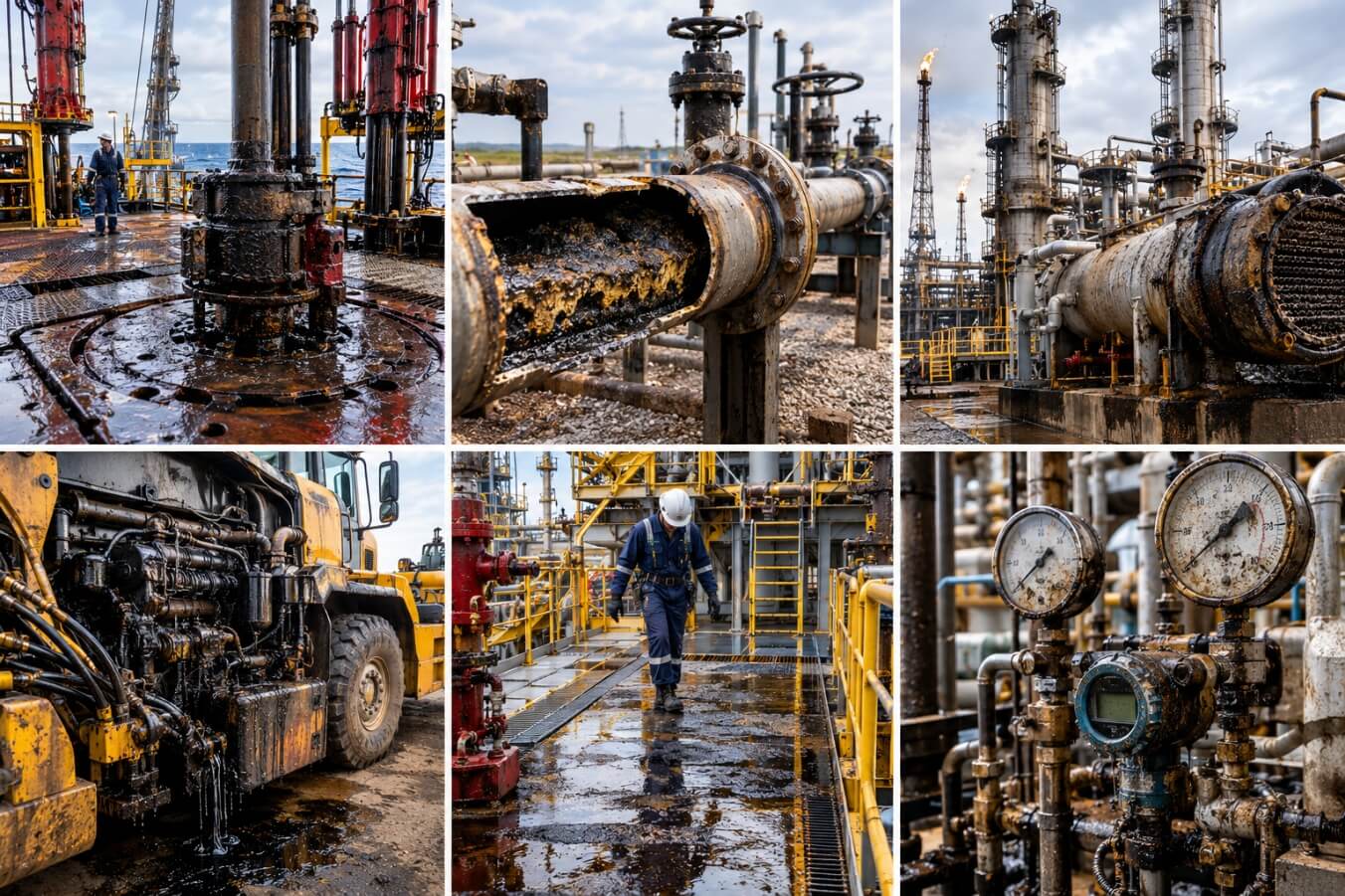
In the oil industry, cleaning equipment and surfaces is an ongoing challenge. Lubricating oils, drilling greases, tar and asphalt deposits, and carbonized residues build up on:
Drilling equipment
Platforms, rigs, and circulation systems.
Pipelines and flowlines
Buildup of paraffins, asphaltenes, and organic deposits.
Refining equipment
Heat exchangers, distillation columns, and furnaces.
Vehicles and heavy machinery
Engines, transmissions, and hydraulic systems.
Work surfaces
Floors, walkways, and maintenance areas.
Measurement equipment
Equipment exposed to hydrocarbons.
The buildup of these deposits creates multiple operational issues. Over time, it can lead to mechanical failures and slip hazards that compromise personnel safety.
Types of degreasers for the Oil Industry
Degreasers used in the oil and gas sector fall into two primary categories based on their composition and mechanism of action:

Solvent-based degreasers
Organic solvent-based degreasers work by dissolving grease and oil deposits through solubilization. These products are typically formulated with surfactants and organic solvents and are specifically designed to clean equipment exposed to tar or asphalt by emulsifying and dissolving these deposits in petroleum-industry piping.
Advantages:
- High dissolving power for heavy grease and carbonized deposits.
- Fast action on difficult contaminants.
Considerations:
- Require handling precautions because of their solvent content.
- May require greater ventilation and additional personal protective equipment.
- Disposal must be managed in accordance with hazardous waste regulations.
Surfactant-based (Aqueous) degreasers
Aqueous degreasers use surfactants to emulsify and suspend grease so it can be removed with water. These products are formulated specifically for oil platforms and equipment, removing oil, grease, and mud without corrosive substances.
Advantages:
- Lower toxicity and an improved environmental profile.
- Biodegradable and nonflammable.
- Not considered hazardous waste under RCRA.
- Compatible with a wide range of materials.
Considerations:
- May require longer contact times for very heavy deposits.
- Effectiveness depends on the specific surfactant formulation.
How degreasers work
A degreaser’s mechanism of action depends on its formulation, but it generally involves several physicochemical processes:
Saponification (in alkaline degreasers)
Alkaline degreasers can react with the fatty acids in animal and vegetable fats, converting them into water-soluble soaps. This mechanism is less effective on mineral-based greases (hydrocarbons).
Mechanical action and rinsing
Pressure rinsing or mechanical agitation helps carry away emulsified or dissolved contaminants, completing the cleaning process.
Surface tension reduction
Surfactants in the formulation reduce water's surface tension, allowing the degreaser to penetrate grease and oil films and spread across the contaminated surface.
Emulsification
Surfactants act at the oil-water interface, forming micelles that encapsulate grease droplets. This process, known as emulsification, suspends the grease in the aqueous medium and makes it easier to remove.
Solubilization (in solvent-based degreasers)
In solvent-based formulations, grease dissolves directly in the organic medium. This mechanism is particularly effective for tar, asphalt, and highly viscous grease deposits.
Zerachem’s approach: an end-to-end solution with technical support
At Zerachem, we understand that cleaning equipment and work areas in the oil and gas industry is a critical operational process. Each operation presents unique challenges that require a tailored solution.
One example is our Zerabio, a biodegradable, low-toxicity degreaser formulated to dissolve and emulsify grease and soils across a wide range of surfaces and industrial applications. Its versatility makes it a key tool for the oil and gas industry because its formulation is specifically designed to manage hydrocarbon spills in inland and marine waters, remediate soils contaminated by crude oil and its derivatives, and clean tanks, pipelines, equipment, and machinery contaminated with hydrocarbons. It also does not cause oxidation or corrosion on metal, electrical, or plastic surfaces, helping protect equipment and extend its service life.
Combined with its ability to minimize environmental impact, remove petroleum residues from piping systems, and support more hygienic environments, these capabilities make it a comprehensive solution for operations that require both technical efficiency and environmental responsibility.
Our industrial degreaser value proposition includes:
Agile reformulation
We adapt formulations to each customer's specific needs, considering the type of deposit, equipment materials, and operating conditions.
Consistent inventory
Immediate availability of critical products to help maintain operational continuity.
Technical sustainability
Biodegradable, low-toxicity formulations with an improved environmental profile.
Specialized guidance
Personalized technical support to select the right degreaser and optimize its application.
Free samples
Evaluate product performance under actual operating conditions with no upfront investment.
FAQ – Frequently Asked Questions
What type of degreaser is used in the Oil Industry?
The oil industry primarily uses two types of degreasers: organic solvent-based degreasers for tar, asphalt, and heavy grease deposits, and aqueous surfactant-based degreasers for general equipment and surface cleaning. Selection depends on the type of contaminant, the materials being cleaned, and applicable regulatory requirements.
However, in recent years, demand has increased for environmentally friendly degreasers that support sustainability in both production and use, leading to the adoption of biodegradable formulations for industrial applications.
What characteristics should a degreaser for the Oil and Gas Industry have?
A degreaser for this sector should provide high removal capacity for mineral-based greases and oils, compatibility with equipment materials such as metals, plastics, and elastomers, an appropriate personnel safety profile, compliance with environmental regulations, and biodegradability when required.
Are industrial degreasers hazardous?
It depends on the formulation. Organic solvent-based degreasers require handling precautions because of their flammability and potential toxicity. Aqueous degreasers based on biodegradable surfactants have significantly better safety and are nonflammable and noncorrosive. Always consult the Safety Data Sheet (SDS) for the specific product.
How are degreasers applied in the Oil Industry?
Degreasers are applied by spraying, immersion, brushing, or recirculation, depending on the equipment and surface being cleaned. On platforms and drilling equipment, manual sprayers or pressure-cleaning systems are used. For pipelines, circulation or displacement methods are used with diluted degreasers.
References
- U.S. Patent US6156716A. Heavy duty degreaser cleaning compositions and methods of using the same. Google Patents. https://patents.google.com/patent/US6156716A/en
- (Chemistry in Everyday Life: Degreasers and Solvents. – Google Search https://prometeo.matem.unam.mx/recursos/VariosNiveles/iCartesiLibri/recursos/Quimica_en_la_vida_cotidiana_desengrasantes_y_disolventes/, n.d.)
Legal notice and disclaimer
This document and all content included in it are provided strictly for informational and educational purposes. Its purpose is to provide a general overview of industrial degreasers and their applications in the oil and gas industry.
The information contained herein does not constitute technical advice or a recommendation to use any specific product. The decision to use, dose, or incorporate any degreaser into a production process is the sole responsibility of the user, contractor, or final formulator, who must have the technical knowledge, infrastructure, and qualified personnel required to carry out these operations safely and in compliance with applicable regulations.
For any real-world application, it is essential to consult and strictly follow the product’s Technical Data Sheet and Safety Data Sheet, as provided by the manufacturer or an authorized supplier.
Why Partner With Us
30 Years Focused on Chemical Excellence
Backed by quality certifications, reliable logistics, and a comprehensive chemical portfolio tailored to your industry.

KOSHER
Certified

Agile
Reformulation

Permanent
Stock

Full Regulatory
Compliance

Technical
Sustainability

Organized
Logistics

Specialized
Consulting
