Food grade Antifoams

Improving efficiency and process reliability

Antifoams and defoamers are essential processing aids that help maintain operational efficiency across a wide range of industrial applications. While the terms are often used interchangeably, they refer to different technical functions.

The choice between an antifoam and a defoamer depends on process conditions and the severity of foam-related challenges. Defoamers are typically used in targeted situations where a foam column has already developed and rapid knockdown is required.

In food processing, antifoams are used more frequently than defoamers because the objective is generally not to wait for foam to appear and then eliminate it, but rather to prevent its formation from the beginning, especially in continuous operations.

This contributes to:

Antifoaming agents

Antifoam

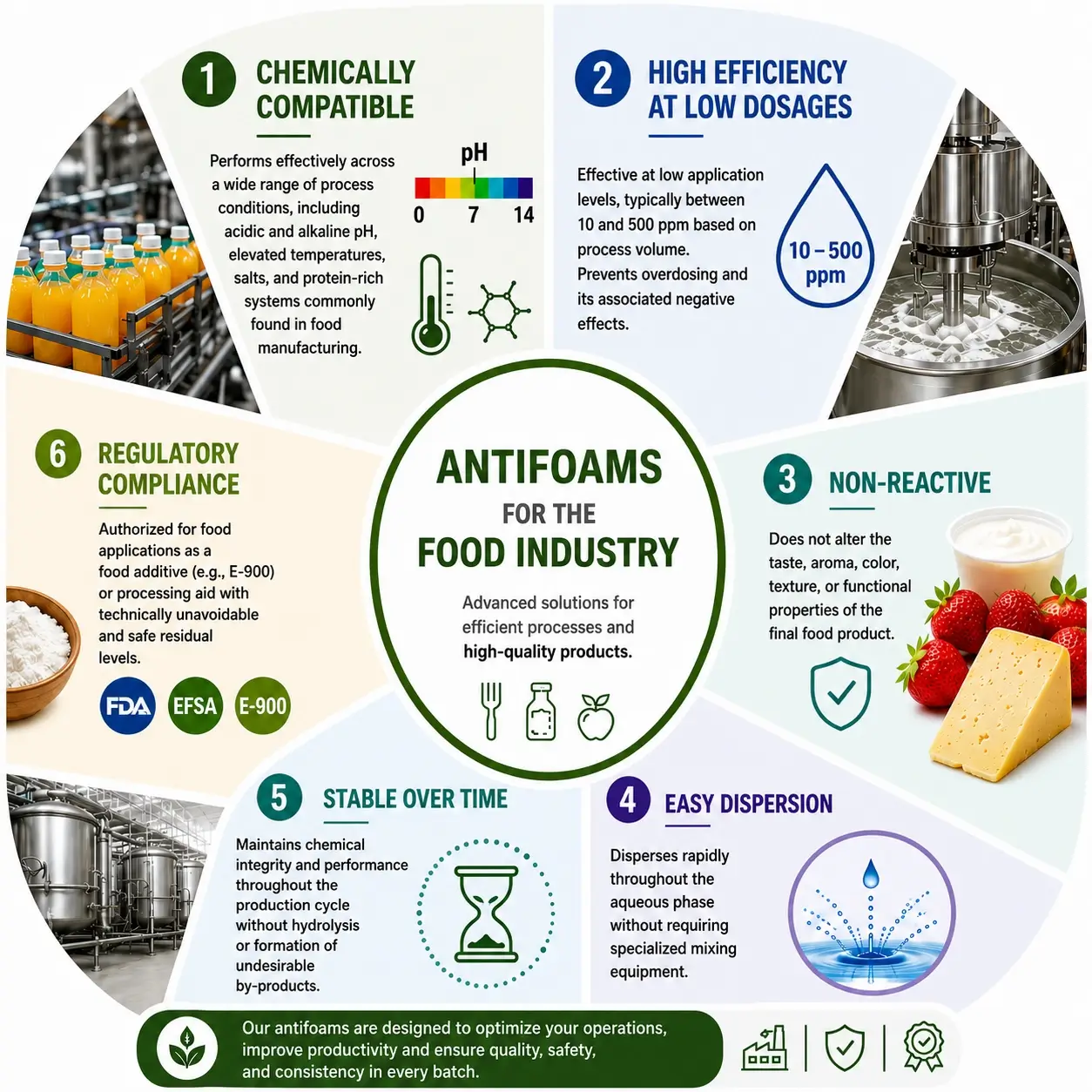
What Defines an effective food-grade antifoam?

Any substance used in food processing must comply with well-defined toxicological and regulatory requirements.1

In practice, this means it must be authorized either as a food additive, when it becomes part of the product, or as a processing aid, when it is not intended to remain in the finished product and only technically unavoidable residues are tolerated within tightly controlled limits. In most cases, processing aids are not required to be declared on the final product label. ¹

food grade antifoam

“Because they can efficiently suppress or eliminate foam, antifoams are considered essential tools in modern food processing from both operational and technological perspectives.”

Silicone Based Antifoam

A Proven Industry Standard

Among the solutions available for food applications, silicone-based antifoams stand out for their high efficiency, versatility, and broad process compatibility.

One of the most widely used systems is dimethylpolysiloxane (PDMS), also known as dimethicone and identified in many markets as E900. In food processing, silicone-based defoaming agents containing dimethylpolysiloxane are regulated for specific applications and usage limits.¹

These systems are widely used in applications such as:

Silicone-based antifoams are also available in powder form for dry-blend applications, offering important operational advantages such as:

Antifoam solution

Foam Control as a Process Strategy

In today’s food industry, foam control is no longer just an operational issue. It is a process decision that directly impacts throughput, operational stability, and final product quality.

When foam is not managed effectively, manufacturers may face raw material losses, unplanned downtime, increased operating costs, and variability in critical processing conditions. For this reason, advanced antifoam technologies have become critical tools for manufacturers focused on process reliability, operational uptime, and high sanitary standards.

At ZERACHEM® FOOD, we develop antifoam solutions specifically engineered to help food manufacturers overcome real-world processing challenges. Our formulations are designed to improve operational efficiency, reduce waste, and maintain stable process performance without compromising the quality or characteristics of the final product.

More than a supplier, we strive to be a technical partner for manufacturers that depend on consistency, traceability, and reliable plant performance to keep production running at its best.

Request a food grade antifoam sample

If you would like more information about our raw materials, please contact one of our expert advisors.

Why Partner With Us

30 Years Focused on Chemical Excellence

Backed by quality certifications, reliable logistics, and a comprehensive chemical portfolio tailored to your industry.

We are the strategic partner for industries that require risk-free operational continuity.

KOSHER
Certified

Agile
Reformulation

Permanent
Stock

Full Regulatory
Compliance

Technical
Sustainability

Organized
Logistics

Specialized
Consulting

Free
Samples